.jpg)

© Bronzewing Farm 2013-26
_gray.png)


Cultivation and Agronomy. Bronzewing
Farm
®
grows select cultivars of Tasmanian
Mountain Pepper (Tasmannia lanceolata).
Most Tasmanian Mountain Pepper is taken
from the Tasmanian bush and consequently
there is only a little information on the
cultivation of the peppers (eg. Ryder, M.,
Latham, Y. & Hawke, B. 2008. Cultivation
and Harvest Quality of Native Food Crops,
RIRDC Publication No 08/019).
There are also some
dreadful reports that
showcase extremely
poor science, so be
careful in the information
you rely on, eg. Jindivick
2018.
Cultivation takes
time, time, and more
time. The plants are
very slow growing...
At full production we
will have 5,000
females bushes
producing around
7,500 kg of
pepperberries.
We have found the
following things
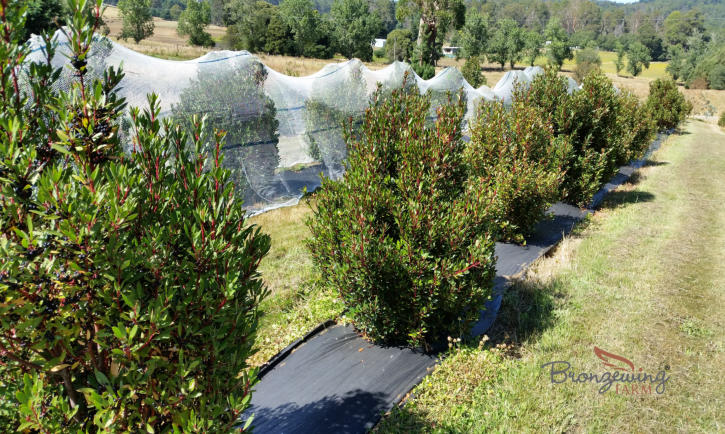
essential: Drip
irrigation, the correct
pH and nutrient
regime, weed
matting and bird
netting prior to
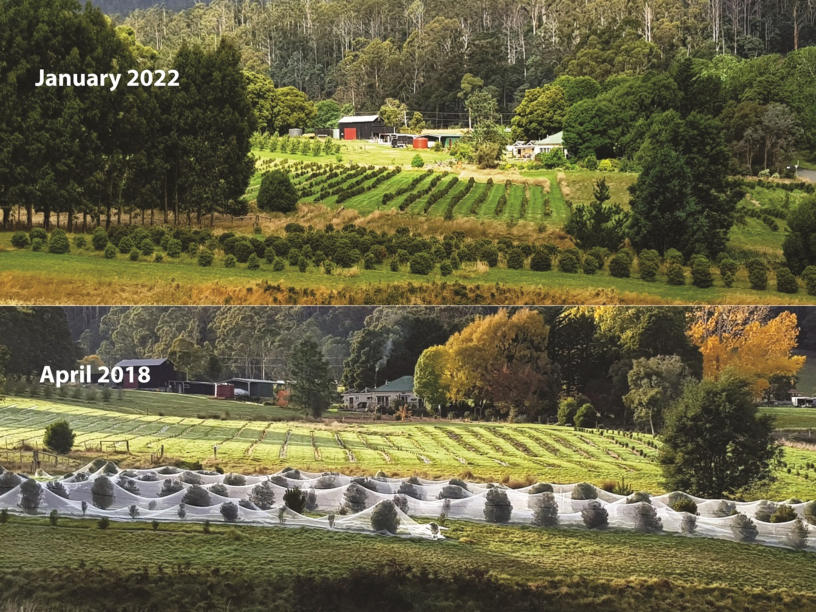
harvest time. Our
planting layout
maximises sun
exposure to each
plant, and we plant
at a ratio of 10
females:1 male.
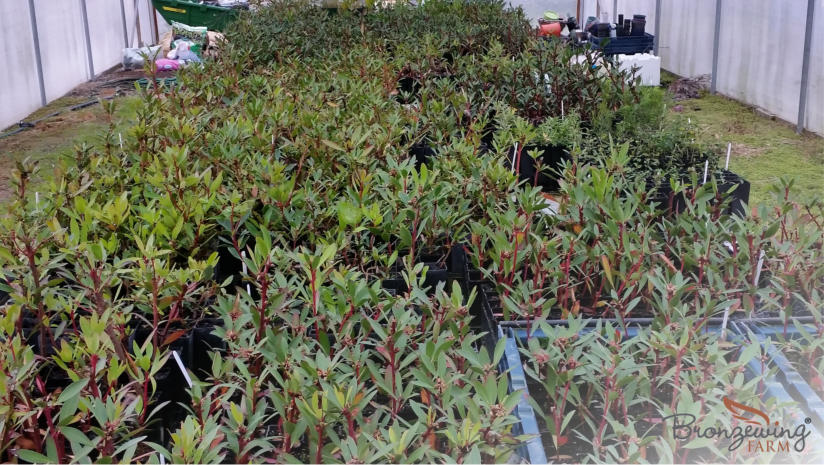
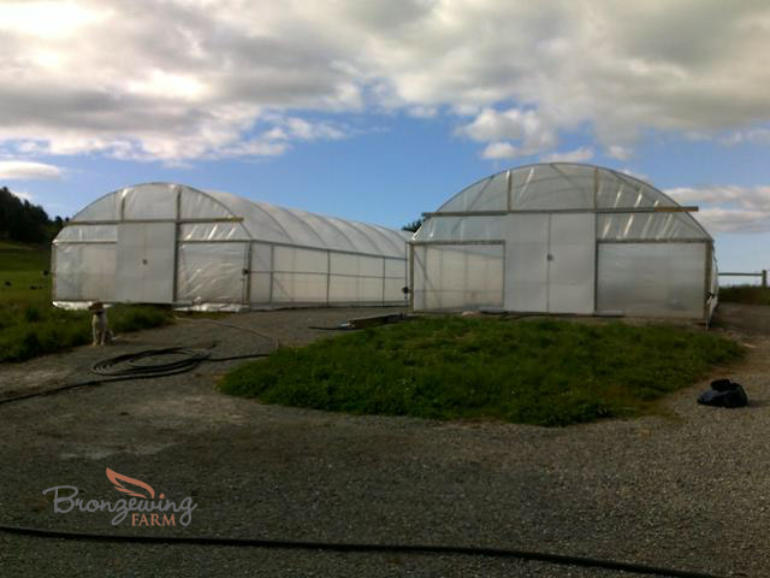
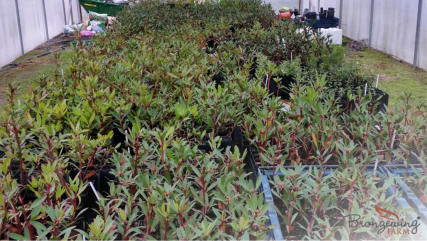
Cuttings from select cultivars are
made in May-June and they undergo
two growth spurts in our greenhouses.
They are usually ready for planting
after 18-24 months. First harvest is
typically around 3-5 years after
planting.
When do the plants start producing
Pepperberries?
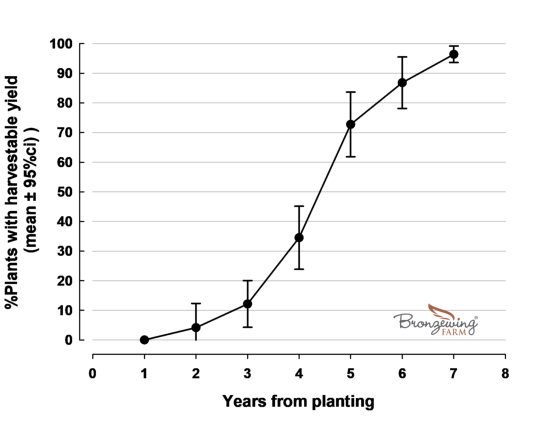
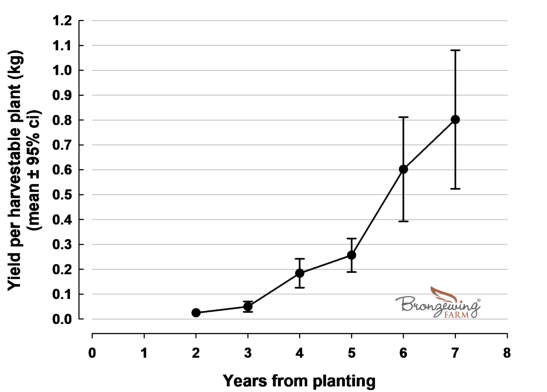
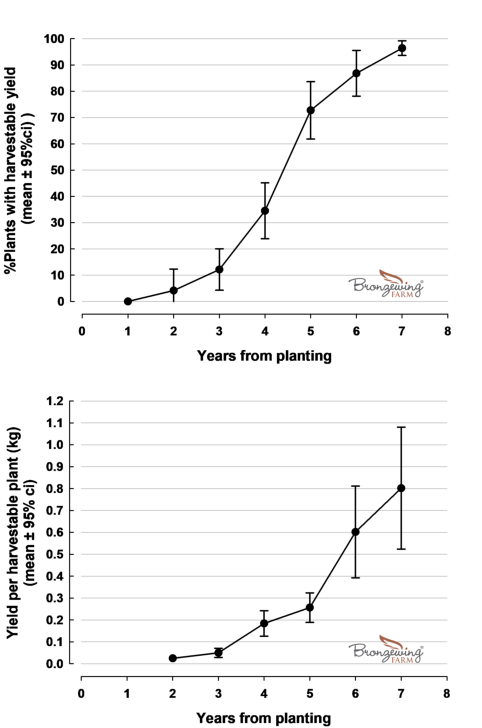
Our experience is that the plants are
at ‘regular production’ by 8 years old.
Even though our plants are clonal
there are differences in when the
plants start to yield and the quantity of
berries produced, but by 7 years,
around 95% of all plants are
producing berries.
What pollinates Tasmanian Mountain Pepper?
This is still an ‘open’ question. It is certainly not honey bees
(see our video: “Bad Bees”). A simple study was undertaken
at the University of Tasmania which looked at what insects,
etc, visited the flowers but there was no extension of that
study to look at yields. Another study suggested that wind
pollination was not involved as the pollen was deemed too
heavy, however, we get winds up to 80 kph and we have
seen pollen on the leaves of adjacent female plants.
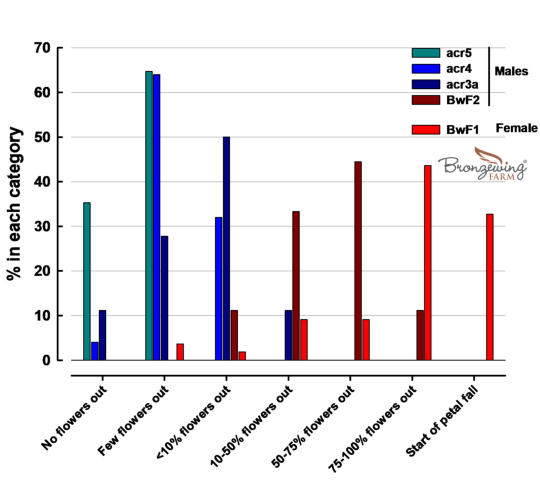
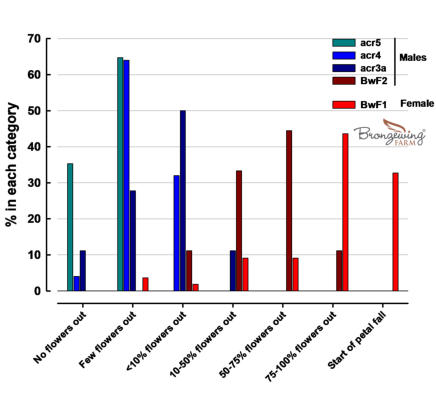
The somewhat complicated graph shown was a ‘snapshot’
of flowering in mid-September 2022. It shows two things
quite clearly: Firstly that the three ‘acr’ male cultivars flower
much later than the BwF2 cultivar, and secondly, that the
female BwF1 has almost finished flowering by the time
BwF2 starts. So, how is Tasmanian Mountain Pepper
fertilised? Anyone want to do a Ph.D.?
How far can female plants be from pollen producing male plants?
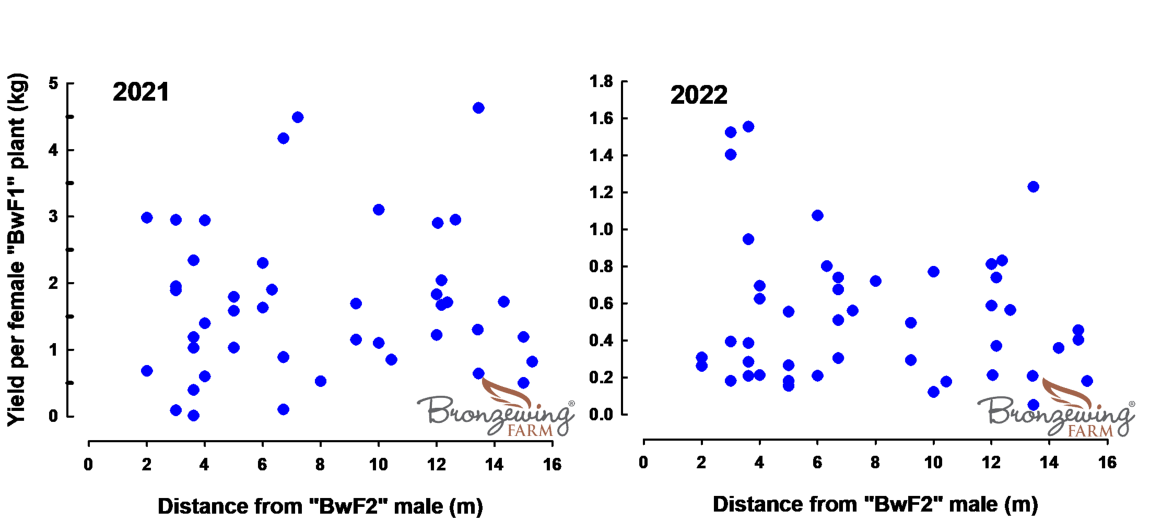
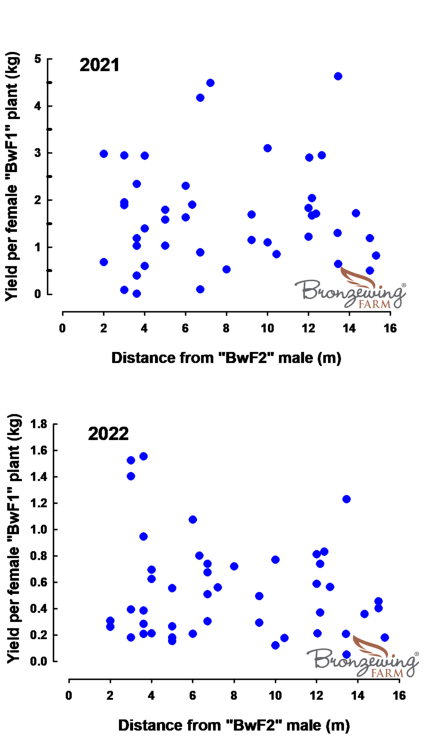
Our plantings have tried to answer this question by looking at the distance individual females are from their nearest male
and recording each plants’ harvest yield. The graphs below suggest that there is little correlation (which is good news).
Note that 2021 was an “on year” and 2022 was an “off year” with considerably reduced yields (which is typical of alternate
bearing crops).
Can the Pepperberry plants change sex?
It may seem an odd question to ask, but some members
of the Winteracaea (the ‘family’ to which the genus
Tasmannia belong) such as Pseudowintera have differing
‘phases’ of female and male flowers often in relation to
temperature or other seasonal impacts. Tasmannia are
believed to be strictly dioecious with female flowers on
one plant, and male flowers on another, Vink (1970) states
that in Tasmannia male flowers the carpels are sterile
with the ovules undeveloped. Well, some times, but not
all the time. in 2025 we found a fully formed pepperberry
on a male plant - just the one, just the one plant. Perhaps
it is like the classic line in the movie Jurassic Park when
Dr. Ian Malcolm (played by Jeff Goldblum) argues that “Life
finds a way”…
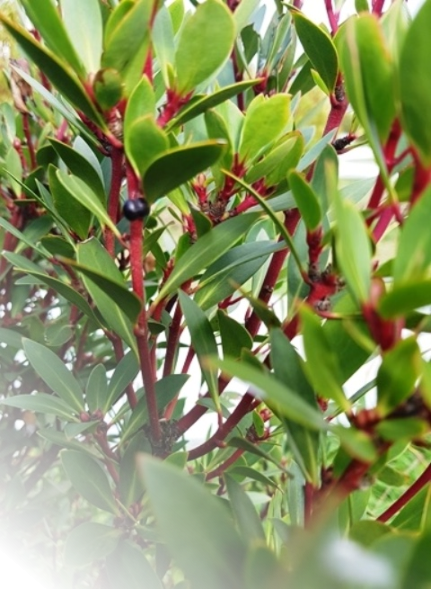
A single pepperberry was found on
one, 8-year-old male plant in 2025






_gray-1.png)

© Bronzewing Farm 2013-26
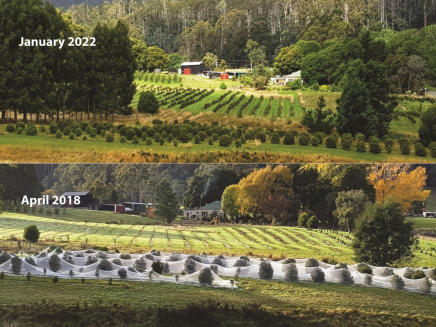
Cultivation takes time, time, and more time.
The plants are very slow growing... At full
production we will have 5,000 females bushes
producing around 7,500 kg of pepperberries.
We have found the following things essential:
Drip irrigation, the correct pH and nutrient
regime, weed matting and bird netting prior to
harvest time. Our planting layout maximises
sun exposure to each plant, and we plant at a
ratio of 10 females:1 male.
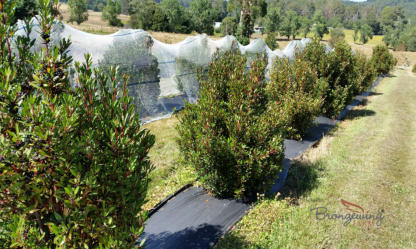
Cultivation and Agronomy. Bronzewing
Farm
®
grows select cultivars of Tasmanian
Mountain Pepper (Tasmannia lanceolata).
Most Tasmanian Mountain Pepper is taken
from the Tasmanian bush and consequently
there is only a little information on the
cultivation of the peppers (eg. Ryder, M.,
Latham, Y. & Hawke, B. 2008. Cultivation and
Harvest Quality of Native Food Crops, RIRDC
Publication No 08/019).
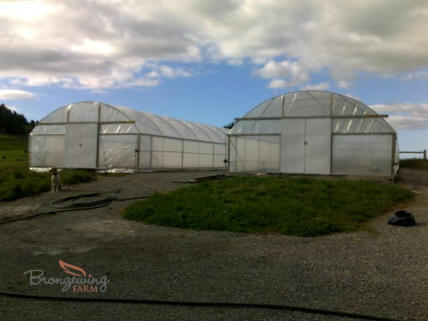
Cuttings from select cultivars are made in May-
June and they undergo two growth spurts in our
greenhouses. They are usually ready for
planting after 18-24 months. First harvest is
typically around 3-5 years after planting.
When do the plants start producing
Pepperberries?
Our experience is that the plants are at ‘regular
production’ by 8 years old. Even though our
plants are clonal there are differences in when
the plants start to yield and the quantity of
berries produced, but by 7 years, around 95%
of all plants are producing berries.
How far can female plants be from pollen
producing male plants?
Our plantings have tried to answer this
question by looking at the distance individual
females are from their nearest male and
recording each plants’ harvest yield. The
graphs below suggest that there is little
correlation (which is good news). Note that
2021 was an “on year” and 2022 was an “off
year” with considerably reduced yields
(which is typical of alternate bearing crops).
A single pepperberry was found on
one, 8-year-old male plant in 2025
What pollinates Tasmanian Mountain
Pepper?
This is still an ‘open’ question. It is certainly not
honey bees (see our video: “Bad Bees”). A
simple study was undertaken at the University
of Tasmania which looked at what insects,
etc, visited the flowers but there was no
extension of that study to look at yields.
Another study suggested that wind pollination
was not involved as the pollen was deemed too
heavy, however, we get winds up to 80 kph and
we have seen pollen on the leaves of adjacent
female plants.
The somewhat complicated graph shown was a
‘snapshot’ of flowering in mid-September 2022.
It shows two things quite clearly: Firstly that the
three ‘acr’ male cultivars flower
much later than the BwF2 cultivar, and
secondly, that the female BwF1 has almost
finished flowering by the time BwF2 starts. So,
how is Tasmanian Mountain Pepper fertilised?
Anyone want to do a Ph.D.?
Can the Pepperberry plants change sex?
It may seem an odd question to ask, but some
members of the Winteracaea (the ‘family’ to
which the genus Tasmannia belong) such as
Pseudowintera have differing ‘phases’ of female
and male flowers often in relation to temperature
or other seasonal impacts. Tasmannia are
believed to be strictly dioecious with female
flowers on one plant, and male flowers on
another. Vink (1970) states that in Tasmannia
male flowers the carpels are sterile with the
ovules undeveloped. Well, some times, but not
all the time. in 2025 we found a fully formed
pepperberry on a male plant - just the one, just
the one plant. Perhaps it is like the classic line in
the movie Jurassic Park when Dr. Ian Malcolm
(played by Jeff Goldblum) argues that
“Life finds a way”…


- Home
- All about Tasmanian DEVIL Mountain Pepper
- >>> The Plant
- >>> Human Health & Nutrition
- >>> Pepper Berry or Leaf?
- >>> Cultivation & Agronomy
- >>> Harvesting
- >>> Drying Techniques
- >>> Devilish Taste
- >>> Celebrity Chef Use
- >>> Why buy our Pepper?
- >>> Use & Tips
- Pepper Shop
- >>> Mountain Pepper
- >>> Tasmanian Pepper Mills
- About us/News & Media/Contact us
- >>> About us
- >>> News and Media
- >>> Wholesale/Bulk Order Enquiry
- >>> Contact us